
Who is This Man?
Bob Stillerman
Palm Sunday, 3-29-2026
Matthew 21:1-11
Matthew 21:1-11
21:1 When they had come near Jerusalem and had reached Bethphage, at the Mount of Olives, Jesus sent two disciples,
21:2 saying to them, “Go into the village ahead of you, and immediately you will find a donkey tied and a colt with her; untie them and bring them to me.
21:3 If anyone says anything to you, just say this, ‘The Lord needs them.’ And he will send them immediately.”
21:4 This took place to fulfill what had been spoken through the prophet;
21:5 “Tell the daughter of Zion, Look, your king is coming to you, humble and mounted on a donkey, and on a colt, the foal of a donkey.”
21:6 The disciples went and did as Jesus had directed them;
21:7 they brought the donkey and the colt and put their cloaks on them, and he sat on them.
21:8 A very large crowd spread their cloaks on the road, and others cut branches from the trees and spread them on the road.
21:9 The crowds that went ahead of him and that followed were shouting, “Hosanna to the Son of David! Blessed is the one who comes in the name of the Lord! Hosanna in the highest heaven!”
21:10 When he entered Jerusalem, the whole city was in turmoil, asking, “Who is this?”
21:11 The crowds were saying, “This is the prophet Jesus from Nazareth in Galilee.”
Sermon: Who is This Man?
The eighth chapter of Matthew recalls a familiar scene: Jesus and his disciples travel by boat across the Sea of Galilee. Jesus elects to take an afternoon nap. The text tells us that a windstorm arises on the sea that is so great, the boat is overcome by waves. And still, Jesus sleeps. The disciples are scared. They wake Jesus up and plead for his help: “Lord, save us! We are perishing!”
Jesus responds, “Why are you afraid, you of little faith?” Then Jesus gets up, rebukes the winds and the sea; and there is a dead calm. And the disciples are amazed, saying, “What sort of man is this, that even the winds and the sea obey him?”
Thirteen chapters later, Jesus will enter another stormy sea: Jerusalem. Here, inside its city walls, Romans and the Jewish establishment wrestle for power, each group seeking to control a city and its people. And with years of practice, the authorities have become skilled at manipulating the people – with one well-planned move, an angry mob can create a tidal wave of violence. And such a mob can quickly dissolve the power of ambitious politicians or righteous prophets.
Jesus, is undeterred, and rides into town on a donkey, the animal associated with Israel’s kingship, and with the ushering in of God’s kingdom or kin-dom. The crowd cheers. They lay down their cloaks. And they wave palm branches. And they cry out: “Hosanna to the Son of David! Blessed is the One who comes in the name of the Lord! Hosanna in the highest heaven!”
Through the gates Jesus goes. As he goes, we’re told the whole city is thrown into turmoil, and its residents ask: “Who is this?”
The traveling pilgrims reply, “This is the prophet, Jesus, from Nazareth in Galilee.”
Who is this Jesus?
And what sort of man is he?
I believe these two questions are the defining questions of Palm Sunday, and indeed the whole of the Gospel of Matthew.
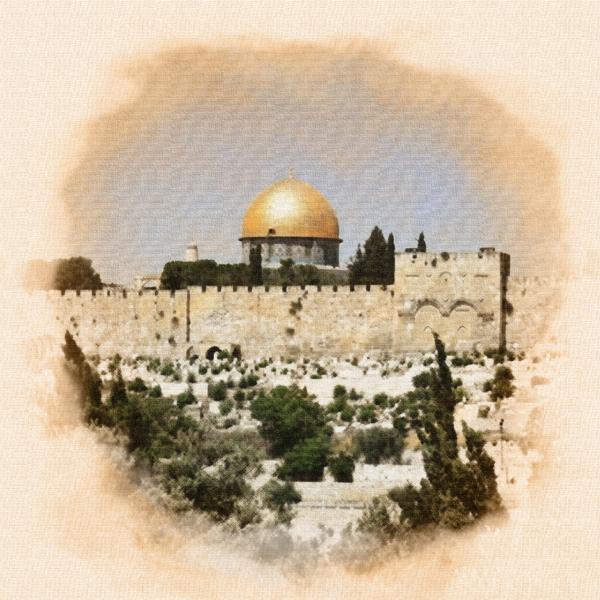
I wasn’t there to march down the Mount of Olives on that first Palm Sunday, but I have marched down the Mount of Olives. And when you stand and see its sweeping vistas, you can’t help but feel like you are on top of the world. The sun stares back at you as it reflects off the golden Dome of the Rock, and the amber-tinted city walls. Today, as it was then, the cityscape of Jerusalem remains a thing of beauty. And when you see this holy place, you feel the wind of God behind you.
I wasn’t there to walk in the steps of the One who traversed the Galilee. I never got to hear his voice, or sit at his table, or ask him the questions the disciples also longed to ask, or even go fishing with him. But I have traversed the Galilee. I’ve seen Capernaum. I’ve waded in the sea. I’ve had a fish dinner by the shore. And I’ve heard the Gospel stories recounted in the very places they originated. And I have felt God’s Spirit in the Galilee.
And when I put myself in the shoes of those who followed him firsthand, I ask, “Who is this Jesus?” And the story calls back to me: “He is the One through whom all things are made possible!”
And when I put myself in the shoes of those who followed him firsthand, I ask, “What sort of man is this?” And the story calls back to me: “He’s not necessarily the man you expect him to be, and sometimes, he’s not even the man you want him to be.”
Because here’s the truth: Just like those pilgrims, and just like those disciples, and just like all those folks who were ready to see a tangible display of kingship and power, I want Jesus to be something I can understand. I want Jesus to do the things that I would do if I had such powers. Here is One who has the power to harness the sea and rebuke the winds. I want Jesus to carry Poseidon’s trident, and in one stamping motion provoke a stream of justice throughout the globe: Stamp, gone is racism; stamp gone are the conflicts in Iran, and Ukraine, and Gaza, and Sudan; stamp, gone are those who lack empathy for others; stamp, an end to exile; stamp, an end to grief, and pain, and loneliness, and meanness, and greed, and politics, and the overwhelming burdens of evil in this world. Stamp, stamp, stamp, stamp…I want them all gone. And I want God’s kingdom – the one with the golden streets and rooms-with-a-view – I want it now. And here, at the top of Mount of Olives, with Jesus in the lead, it sure feels like it can happen in a flash. I want to see the Moses-side of Jesus. And I want to enter that promised land. Today. Right now. Let’s get started.
It’s hard, but I must admit that today, here on Palm Sunday, Jesus is not the man I expect him to be, nor is he the man I want him to be.
Still, still, still, the story calls to me through the ages: “Jesus may not be what you expect; Jesus may not be what you want; but Jesus is always who you need him to be.”
My limited Hebrew takes me back to the word Hosanna. These days, and particularly in the context of Palm Sunday, and in Matthew’s text, we translate the word Hosanna as a call to praise. “Praise God in the highest heavens.”
But Jesus paid attention in Hebrew class, something I never did. Hosanna is better translated, “Save us.”
Today, as it was then, we believe that our safety is contingent upon the power of earthly kingdoms – strong, dominant, wealthy governments. For today, as it was then, we cling to the tangible idea of power: might makes right. And we run to jump in line for the parade that will announce its coming.
At those city gates, Jesus will not be the man we expect him to be. Nor will Jesus be the man we want him to be. Jesus will be the man we need him to be.
Jesus will not split the Red Sea. Jesus will not implement a coup to usurp Caesar’s crown. Jesus will not use Poseidon’s trident to zap away the bad guys.
Jesus will simply walk down the hill, continuing the same tenants and disciplines that have defined his entire ministry, continuing a masterful adherence to the Spirit of Torah: Jesus will listen; Jesus will proclaim God; Jesus will love; Jesus will laugh; Jesus will cry; Jesus will break bread; Jesus will give of himself; Jesus will do justice; and love mercy; and walk humbly with his God. And his trust will not be in men, nor horses, nor weapons, nor laws, nor systems – his trust will be in God. And that trust tells him to look past the pain of Friday to the hope of Sunday.
On Palm Sunday, the world needs someone who can understand a vision much bigger than any of ours: God’s possibilities extend beyond the farthest reaches of our imagination. High on that hill, Jesus has his mind set on such possibilities. It will be an unlikely coronation: a common donkey; a carpet of palms and peasant coats, and eventually a crown of thorns with mocking jesters, and a cruel ending. But Jesus knows it’s just the coronation we need. For this is a coronation that ends not in dominance, but in love.
Who is Jesus? He is Messiah?
And what sort of man is he? He’s the kind of man we need him to be.
He’s the kind of man who knows how to properly translate our cries of loud hosannas. Save us! And save us, he shall – with love, with love, with love, with love – love that never ends!!!
Thanks be to God. Amen.