
On This Mountain
Bob Stillerman
Third Sunday of Lent, 3-8-2026
John 4:23-26
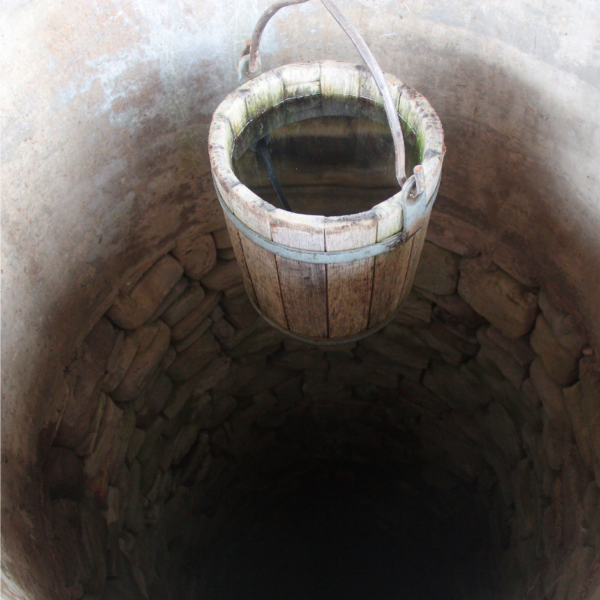
Our lectionary text this morning is 800 words long. It’s the story of the woman at the well, and it’s not a text that is easily segmented or separated. I believe the best way to engage this text is to first read John’s prologue (1:1-14) and then read our story (4:5-42). So…here’s a homework assignment for you. Read these two texts this week. Follow the stages of the journey this woman takes from curiosity to genuine interest to belief to discipleship. And then think about your own interactions with neighbors, and your own process for discovering God in your midst. What is your source for living water? Where are you looking for it? How open are you to its receipt?
For my part, I want to focus on four verses: 4:23-4:26. I’m going to read you two translations, one from the NRSV, and one from Clarence Jordan’s Cotton Patch Gospel. Hear now these good words:
John 4:23-26, NRSV
4:23 “But the hour is coming and is now here when the true worshipers will worship the Father in spirit and truth, for the Father seeks such as these to worship him.
4:24 God is spirit, and those who worship him must worship in spirit and truth.”
4:25 The woman said to him, “I know that Messiah is coming” (who is called Christ). “When he comes, he will proclaim all things to us.”
4:26 Jesus said to her, “I am he, the one who is speaking to you.”
John 4:23-26, Cotton Patch Gospel
4:23 Jesus says, “Just the same, the time is coming – it’s already here – when the sincere worshippers will worship God in Spirit and with honesty.
4:24 Indeed, God is looking for people to worship like that. God is Spirit, and when people worship God, they must do so in spirit and with honesty.”
4:25 The lady answers: “I realize that Christ (the word for Leader) is coming. When he does. He’ll straighten us out on everything!”
4:26 Jesus says to her, “I myself, the person talking with you, am he!”
Sermon: On This Mountain:
Jesus begins his outward ministry, and he tells the disciples that he must go through Samaria, and the first thing we read about the journey is that he stops to rest in the middle of a blazing hot day at a well in what appears to be the middle of nowhere.
To the uniformed reader, the setting of our story is insignificant. Just a map dot off the beaten path. A serviceable well adding relief to an unrelenting heat. But Sychar, it’s also been known as Shechem, is much more than a map dot. Sychar is central in the story of our faith ancestors.
It is here that God promises the land of Israel to Abram. It is here at this well that Isaac’s servant meets Rebekah, and it’s here where Jacob meets Laban’s daughter Rachel. Legend has it that Jacob digs this well 75-feet deep with his own hands, and that he gives this land to Joseph and all his descendants. And it is here, hundreds of years later, that Joshua leads the people of Israel into the Promised-Land, and Joshua, standing on this very mountain proclaims to the Israelites and all the generations to follow, “Choose this day whom you will serve…As for me and my house, we shall serve the Lord!”
We are in a place that objectively matters.
But our story is taking place in a time where subjectivity holds sway over objectivity.
Sychar, or Shechem, is in Samaria. How does that change our perspective?
Samaria is the remnant of the Northern Kingdom. It’s fitting that our lectionary passage is 800 words long, because we are seeking to untangle more than 800 years of traumatic history. Yes, King David and Solomon manage to unite Israel’s twelve tribes into a thriving kingdom in the Tenth Century BCE. After their death, however, the kingdom splits, creating Israel, with its capital, Samaria in the North, and Judah, with its capital, Jerusalem in the South. The fortunes of Israel fade much faster than those of Judah, and by the mid-700s, Israel is destroyed by the Assyrians, creating centuries of increasing marginalization from their Southern kin.
Like the children of Cain, and Hagar, and Reuben, the children of Samaria have been cast out of the circle of God’s chosen – they are the discards from the pruning of Israel’s family tree.
Here’s the prevailing narrative given by Jews of Samaritans in the time of Jesus. Nearly 800 years ago, they were weak. They did not trust YWHW, and so they made allegiances with the Assyrians, who eventually conquered their 10 tribes. The Assyrians filled their land with new people, new Gods, and new customs. And these ten tribes eventually married women who were not Jewish, and they worshiped Gods who were not YHWH. They were no longer pure, they were no longer chosen. They were half-breeds, certainly not Jewish enough, and certainly not faithful enough to remain in community.
And when their Southern brothers and sisters, the real Jewish folks, were deported to Babylon in the 500s, the Samaritans remained in Shechem. They even had the audacity to claim that proper temple worship occurred at their shrine of Mt. Gerizim, not the Jerusalem Temple.
So, supposedly, we’re occupying a space, where even though many sacred moments have occurred, God is deemed to be absent. What good can come from Jesus being in a place like this?
And then, of course, we must consider our conversation partners. Jesus is an unconventional Jewish Rabbi in a foreign context, seeking dialogue with a Samaritan woman who is in an unconventional living arrangement. And there are similarities to last week’s nighttime encounter with Nicodemus. Nicodemus represents the Pharisees, those priests whose bloodlines fail to afford them privilege. The Samaritan woman represents a group of people discarded and pushed aside. And while Nicodemus seeks the cover of night to converse with Jesus, the Samaritan woman resides in the cover of day, the time affording her the most safety from disapproving neighbors.
The location is suspect. The participants are suspect. The time of day is suspect. And even the topics are suspect.
Last week rebirth through the Spirit. This week, living water.
I believe the picture that is becoming more and more evident as we progress through John’s gospel is that the presence of God, the inbreaking love of God, the Spirited, transformational moments, defy expectation. And tradition. And privilege. And tired narratives.
We lauded Nicodemus as a seeker last week. And eventually, we will laud his discernment and discipleship. But this week, we not only laud the curiosity of the Samaritan woman, we laud her determination to seize this very moment.
You see, she is keen. She is wise. She is bold. She is earnest. And she’s asking the right questions.
“I worship God on my mountain,” she says to Jesus, “And you on yours. And you speak of yours alone as truth.”
Jesus mostly affirms her statement, and he reiterates that the day is coming when people won’t worry so much about the mountain of worship, but more so about worship rooted in Spirit, the felt presence of God, and Truth, the revelation of God’s goodness. But I believe, at this point in the gospel story, Jesus, and most certainly the author who represents John’s community, are still in a space of transition. Because verse 22 is really, really off-putting. Essentially, Jesus states that Samaritans don’t yet see truth, but Jewish people do, and are the source of salvation. I choose to read this sentiment as something that’s giving way to an in-breaking future, but I acknowledge the verse can be used in dangerous ways if we’re not careful.
All of this is to say that the Samaritan woman, no matter how unlikely her status, becomes the first theological partner of Jesus in this Gospel, and she very clearly articulates the movement of God, and the direction of Jesus’ ministry. And then, then, best of all, she grounds this articulation in the anticipation of a Leader who’s gonna straighten things out, set the whole process in motion. And Jesus says, “That’s me!”
What we have today, is a Jesus just beginning to comprehend a resurrection process that will profoundly connect God to the human experience, changing the entire trajectory of the world. And he’s navigating a religious structure that insists on the form and shape of this experience. And all the while he’s talking to a person, who despite her spiritual depth, has been pushed aside, because her narrative isn’t palatable enough for the status quo.
This is Jesus’ first utterance of “I am.” He’s saying the quiet part out loud. I am Messiah. And here, with a complete stranger, both of them are expressing the great eschatological hope – that’s the end time hope, the big picture, the final reveal, of the One who’s gonna set things right. Perhaps the Messiah who’s been promised for THEN, is being experienced RIGHT NOW; the not-yet that will someday be is happening before our very eyes. At a well. On a famous hill. In noonday heat. Two renegades daring to drink from the same ladle. And it’s not lost on me, whether you believe I’m mixing my gospels or not, that the tradition of Hagar, and Reuben, and Cain, and an unnamed woman at the well, rubbed off on a Samaritan traveling the Jericho Road, one whose actions toward a wounded stranger we deem good, and one whose hospitality we seek to mimic.
This isn’t THE story of Resurrection, but it’s got a resurrecting quality. You see, so often, I find myself occupied with how something new birthed within me might bring some balm to a broken world. How might I of Jerusalem, help heal you of Samaria. When all the all while, a reciprocal quality exists: They of Samaria are also healers of me of Jerusalem.
Lord, give us the courage to seek water in noonday heat, to make friends with unlikely conversation partners, to worship on different mountains, to glean new wisdom together, and to experience the One who will set it all straight, not just THEN, but right NOW, too.
Amen.