
Don’t Miss the Forest for the Miracle
Pentecost Four, 7/6/2025
Bob Stillerman
Daniel 3
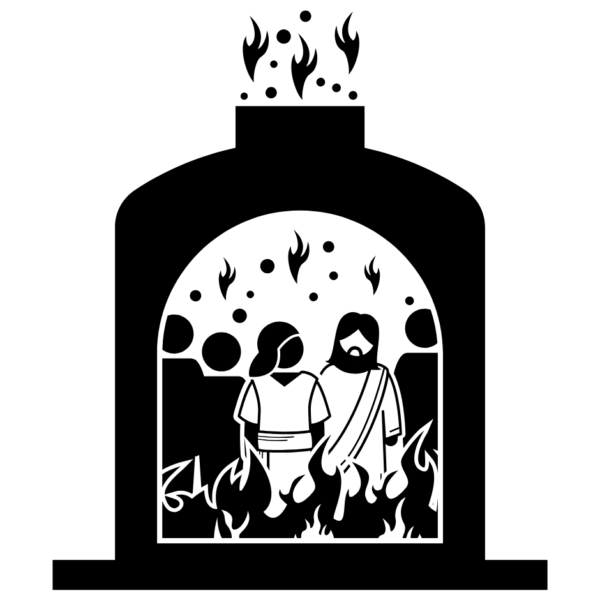
Daniel 3
King Nebuchadnezzar made a golden statue whose height was sixty cubits and whose width was six cubits; he set it up on the plain of Dura in the province of Babylon. 2 Then King Nebuchadnezzar sent for the satraps, the prefects, and the governors, the counselors, the treasurers, the justices, the magistrates, and all the officials of the provinces to assemble and come to the dedication of the statue that King Nebuchadnezzar had set up. 3 So the satraps, the prefects, and the governors, the counselors, the treasurers, the justices, the magistrates, and all the officials of the provinces assembled for the dedication of the statue that King Nebuchadnezzar had set up. When they were standing before the statue that Nebuchadnezzar had set up, 4 the herald proclaimed aloud, “You are commanded, O peoples, nations, and languages, 5 that when you hear the sound of the horn, pipe, lyre, trigon, harp, drum, and entire musical ensemble, you are to fall down and worship the golden statue that King Nebuchadnezzar has set up. 6 Whoever does not fall down and worship shall immediately be thrown into a furnace of blazing fire.” 7 Therefore, as soon as all the peoples heard the sound of the horn, pipe, lyre, trigon, harp, drum,[a] and entire musical ensemble, all the peoples, nations, and languages fell down and worshiped the golden statue that King Nebuchadnezzar had set up.
8 Accordingly, at this time certain Chaldeans came forward and denounced the Jews. 9 They said to King Nebuchadnezzar, “O king, live forever! 10 You, O king, have made a decree, that everyone who hears the sound of the horn, pipe, lyre, trigon, harp, drum, and entire musical ensemble, shall fall down and worship the golden statue, 11 and whoever does not fall down and worship shall be thrown into a furnace of blazing fire. 12 There are certain Jews whom you have appointed over the affairs of the province of Babylon: Shadrach, Meshach, and Abednego. These men pay no heed to you, O king. They do not serve your gods, and they do not worship the golden statue that you have set up.”
13 Then Nebuchadnezzar in furious rage commanded that Shadrach, Meshach, and Abednego be brought in, so they brought those men before the king. 14 Nebuchadnezzar said to them, “Is it true, O Shadrach, Meshach, and Abednego, that you do not serve my gods and you do not worship the golden statue that I have set up? 15 Now if you are ready, when you hear the sound of the horn, pipe, lyre, trigon, harp, drum, and entire musical ensemble, you should fall down and worship the statue that I have made. But if you do not worship, you shall immediately be thrown into a furnace of blazing fire, and who is the god who will deliver you out of my hands?”
16 Shadrach, Meshach, and Abednego answered the king, “O Nebuchadnezzar, we have no need to present a defense to you in this matter. 17 If our God whom we serve is able to deliver us from the furnace of blazing fire and out of your hand, O king, let him deliver us.[b] 18 But if not, be it known to you, O king, that we will not serve your gods and we will not worship the golden statue that you have set up.”
19 Then Nebuchadnezzar was so filled with rage against Shadrach, Meshach, and Abednego that his face was distorted. He ordered the furnace heated up seven times more than was customary 20 and ordered some of the strongest guards in his army to bind Shadrach, Meshach, and Abednego and to throw them into the furnace of blazing fire. 21 So the men were bound, still wearing their tunics,[c] their trousers,[d] their hats, and their other garments, and they were thrown into the furnace of blazing fire. 22 Because the king’s command was urgent and the furnace was so overheated, the raging flames killed the men who lifted Shadrach, Meshach, and Abednego. 23 But the three men, Shadrach, Meshach, and Abednego, fell down, bound, into the furnace of blazing fire.
24 Then King Nebuchadnezzar was astonished and rose up quickly. He said to his counselors, “Was it not three men that we threw bound into the fire?” They answered the king, “True, O king.” 25 He replied, “But I see four men unbound, walking in the middle of the fire, and they are not hurt, and the fourth has the appearance of a god.”[e]
26 Nebuchadnezzar then approached the door of the furnace of blazing fire and said, “Shadrach, Meshach, and Abednego, servants of the Most High God, come out! Come here!” So Shadrach, Meshach, and Abednego came out from the fire. 27 And the satraps, the prefects, the governors, and the king’s counselors gathered together and saw that the fire had not had any power over the bodies of those men; the hair of their heads was not singed, their tunics[f] were not scorched, and not even the smell of fire came from them. 28 Nebuchadnezzar said, “Blessed be the God of Shadrach, Meshach, and Abednego, who has sent his angel and delivered his servants who trusted in him. They disobeyed the king’s command and yielded up their bodies rather than serve and worship any god except their own God. 29 Therefore I make a decree: Any people, nation, or language that utters blasphemy against the God of Shadrach, Meshach, and Abednego shall be torn limb from limb and their houses laid in ruins, for there is no other god who is able to deliver in this way.” 30 Then the king promoted Shadrach, Meshach, and Abednego in the province of Babylon.
Historical Context:
Today’s lesson is from the book of Daniel. We often talk about the exile, or the exilic period. When we say exile, we mean that around 587 BCE, or nearly 600 years before the birth of Jesus, the Southern Kingdom of Judah was conquered by Babylon. But it wasn’t just colonized. It was raided and decimated. The Babylonians captured all that remained of Judah’s brightest and strongest and youngest citizens, and carried them away to Babylon, violently and forcefully subduing them into the service of the king.
The book of Daniel is written amid exile, possibly as early as about 300 and as late as 150 BCE. And it reflects the feelings of an assimilated people. How do we keep God’s covenant in a far-away land, in a place with no Temple, among people who do not understand our God? But most importantly, how do we help future generations remember the story of the God we serve?
As we reflect on today’s story, we should ask ourselves how we might feel if we were far from home in the service of our captors? How would we balance the demands of our new king with the desire to worship God authentically?
Homily
Don’t get me wrong, I love a good miracle story as much as the next person. I do. I really, really do. But…But, too often, I believe we miss the forest for the miracle.
For instance, sometimes, when we talk about Jesus, we only seem to remember miracles: the resurrection, or Jesus walking on water, or Jesus helping blind persons to see, or Jesus turning water into wine. These are great stories to be sure. But if we spend so much time on the resurrection, we may tend to de-emphasize the kind of life Jesus lived, and the love that was made manifest to us by such a life. If we focus so much on Jesus’ levitating above the Sea of Galilee, or practicing Lasik surgery before it ever existed, we may tend to de-emphasize Jesus’ ability to create transformative, life-giving relationships with his presence. And if we spend so much time focusing on Jesus’ winemaking abilities, we may overlook the role of his mother Mary – she was, after all, a catalyst in helping Jesus to channel, and ultimately use his remarkable gifts. And we may even forget to ask the most important question: Was the wine any good? How did it taste?
Today’s story is no different. Please don’t miss the forest for the miracle.
Yes, it is impressive. Somehow, someway, the Three Young Men survived the fiery furnace – their tunics were fire-proofed long before the textile experts at State and Clemson could ever dream of designing such innovative fabrics. And as Grace Hawthorne’s VBS song reminds us:
It isn’t hot, Whew! in the furnace man
It isn’t hot, Sss! in the furnace man
It isn’t hot in the furnace, man this furnace is cool, cool, cool, cool
All of this helps us remember the story. But here’s the life-changing detail. The idol is built. The order is decreed. The fiery furnace is stoked. And the king demands an answer:
Shadrach, Meshach, and Abednego answered the king, “O Nebuchadnezzar, we have no need to present a defense to you in this matter. If our God whom we serve is able to deliver us from the furnace of blazing fire and out of your hand, O king, let him deliver us. But if not, be it known to you, O king, that we will not serve your gods and we will not worship the golden statue that you have set up.” (Daniel 3:16-18)
The conviction of these three men is not based on an assurance of God’s response to an imminent threat. Instead, their conviction is undergirded by faith in a God who has taught them what is right.
These men are covenant people. When the Deuteronomist writes about a covenant whose words are to be kept in mind and soul, and bound as a sign on our hands, and fixed as an emblem on our foreheads, and taught to our children, and talked about at home and away, during night and day – these men listen. And these men act. Their God is not absent in Babylon. Their God is present.
What they’re saying is that if they must choose between worshiping God in a fiery furnace, or worshipping Nebuchadnezzar in the A/C, they’re gonna choose the furnace every time. Because living a life that doesn’t love and honor God, well, it’s not really living. And it’s certainly not living free.
I believe that’s the real miracle of our story. In every age, women and men are offered Caesar’s finest fruit – just one little catch – acknowledge Caesar’s lordship above all else. Do it, just say the words, and privilege will be yours.
And in every age, women and men of conviction appear: The system will do what it must, and it may be that the system will do its worst. But that system will not do so at the expense of breaking covenant. Might will never deter right.
A few other details I hope you won’t miss in this story. We remember them as Shadrach, Meshach, and Abednego, but these aren’t their given names. Hananiah, Mishael, and Azariah were names that honored the God of Israel. Their new names honored the gods of Babylon. The Three Young Men were forbidden from using their given names, speaking their native tongues, expressing their native traditions, practicing the most instinctive and visual elements of their discipleship. And yet, still, STILL, they persisted in living out an authentic faith.
It also shouldn’t be lost on us that King Nebuchadnezzar sets this idol in the plains – the place where all the laborers toil the fields. The Babylonians are subjected to worshiping an idol of oppression that is paid for with their own sweat and toil. And to make matters worse, they do so amid the pomp and circumstance of a musical ensemble.
And note the time of our text’s composition. It corresponds to the cruelty of leaders like the Greek ruler Antiochus Epiphanes IV, who sullied the Jewish priesthood with political appointees, and installed statues of Zeus in the Temple. The idol is reference to the insertion of the profane into every aspect of living.
And so…in many ways, this story is a parable critiquing empire. And what’s tricky, is that too often, we, those who regard ourselves as faithful disciples, assume we are the Three Young Men in the story. But how often do we insist on an Americanized gospel? How often do we strive to hear and express God’s truth in languages, customs, and traditions beyond our own? It’s a worthy question on a weekend of national reflection.
Friends of Millbrook Baptist Church, it’s unlikely that most of us will soon face a fiery furnace. But that doesn’t mean we won’t encounter our own golden statues, or own stretches of adversity.
God calls us to protect the marginalized, but sometimes that means chipping away at the foundations of our comfort. God calls us to offer a prophetic voice, but sometimes the foreman will not want to hear our opinion. God calls us to be righteous and decent and even different, but sometimes that makes us stick out like sore thumbs. And the flag beckons our salute, and there’s a marching band, and the tune is catchy, and hey man, what’s the matter with a little A/C? Why rock the boat? Why speak out of turn? What’s the harm?
Hear, O Israel: The Lord is our God, the Lord alone.[a] 5 You shall love the Lord your God with all your heart, and with all your soul, and with all your might. 6 Keep these words that I am commanding you today in your heart. 7 Recite them to your children and talk about them when you are at home and when you are away, when you lie down and when you rise. 8 Bind them as a sign on your hand, fix them as an emblem[b] on your forehead, 9 and write them on the doorposts of your house and on your gates.
Good friends, old King Nebby-K’s got the seal, and the band, and the power, and the army, and all the trimmings. And he’ll tell you that life’s about one thing: “Don’t get burned.” And we think the miracle is that God’s got flame-retardant powers.
But the three young men, and I would add, lots of other young ladies and men, too, had, still have it right: the miracle is the love created for one another in a life wholly-attuned to the will of God.
And this morning, every morning, I see a whole forest full of Millbrook Oaks. And I wonder, if we become a forest full of covenant people, what need have we of golden statues, and what fear have we of a fiery furnace?
After all, we’re living in another kind of furnace – God’s presence. And it’s cool, cool, cool in God’s presence. May it always be so!