
What Should Have Been
Bob Stillerman
Third Sunday of Easter, 4-19-2026
Luke 24:13-35
Luke 24:27-35
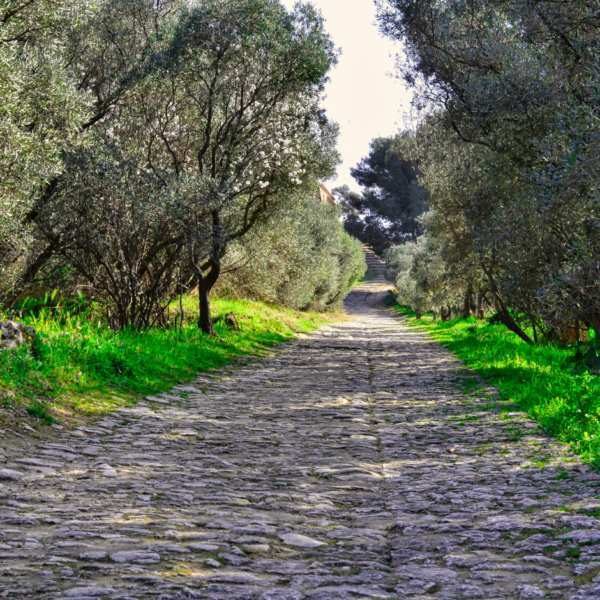
24:27 Then beginning with Moses and all the prophets, he interpreted to them the things about himself in all the scriptures.
24:28 As they came near the village to which they were going, he walked ahead as if he were going on.
24:29 But they urged him strongly, saying, “Stay with us, because it is almost evening, and the day is now nearly over.” So he went in to stay with them.
24:30 When he was at the table with them, he took bread, blessed and broke it, and gave it to them.
24:31 Then their eyes were opened, and they recognized him, and he vanished from their sight.
24:32 They said to each other, “Were not our hearts burning within us while he was talking to us on the road, while he was opening the scriptures to us?”
24:33 That same hour they got up and returned to Jerusalem, and they found the eleven and their companions gathered together.
24:34 They were saying, “The Lord has risen indeed, and he has appeared to Simon!”
24:35 Then they told what had happened on the road and how he had been made known to them in the breaking of the bread.
In 1991, the Atlanta Braves were supposed to win the World Series. But Kent Hrbek is a cheater. That’s right, he’s a cheater! He pulled Ron Gant off of first base. Just do a Google search. You’ll see. As a matter of fact, it’s the first thing that will pop up. Oh, don’t get me wrong, I’m sure Mr. Hrbek’s a nice person. But he’s still a cheater. Also, the Minnesota Twins played in the Metro Dome, a domed stadium, and it’s a known fact that the maintenance crew would turn on the blowers in the outfield to manipulate field conditions. In the top of the inning, when the visiting team batted, the air blew in. In the bottom of the inning, when the home team batted, the air blew out. Those friendly winds helped Kirby Puckett’s lazy fly ball turn into a walk-off, game-winning homer in Game Six. The Twins would go on to win the World Series the next night in Game Seven.

That wasn’t supposed to happen. My brothers and I were supposed to have a post-game party in our living room, huddled around a 19-inch television. Instead, the next day, we went to school bleary-eyed, and I can assure you, I retained zero knowledge in geometry class. And almost thirty-five years later, it still doesn’t seem fair.
I was supposed to get an A on my first Calculus test as a freshman at Furman University. I got a 44. Believe it or not, that was one of the better test results of the semester! That’s not how college was supposed to start.
I could go on with a hundred more examples, and I’m sure similar stories come to mind for you as well.
If we live long enough, or if we live lively enough, there will come a time when we invest ourselves wholly and fully into something: a job, a test, an interview, a relationship, an election, a cause, an organization, a career, a path…And at some point, the investment we put in will not deliver the expectation we imagined. We imagine Future A: a victory parade; monies not-yet-earned, but already spent in our minds; the perfect, happy ending to a story: sunsets and true love and neat, little containers of goodness. And then…Future A doesn’t materialize: no victory parade; window shopping stays window shopping; and messy, tangled endings, with pain, and anxiety, and grief, and disappointment.
I don’t mean to minimize the pain and disillusionment the disciples must have felt on that first Easter weekend by comparing their feelings to a lost ballgame or bad test score. But maybe these smaller feelings help us understand, even in a marginal way, the plight of the two men walking the Road to Emmaus.
Just 48 hours ago, twelve disciples (not to mention the countless unnamed disciples), were following in the footsteps of Jesus. For nearly three years, they had seen God at work: healing, teaching, loving, lingering through the Galilee. Here, in Jesus, was a man who stilled the sea who helped blind persons see; who made scriptures accessible to everyone; who trusted wholly and fully in the security God would provide; who never seemed anxious; who never seem flustered. When the disciples were in his presence, they believed everything was going to be okay. In the presence of Jesus, the disciples floated through tumultuous times, dreaming of God’s world breaking into the present.
And then. A trial. A crucifixion. A death. And pain. And grief. And Sabbath. And now today – the tomorrow they didn’t want to see. A bleak, hopeless tomorrow. A monotonous tomorrow. A present, and a future that isn’t supposed to feel like this. Jesus was going to make them fishers of people. But now, they’re just plain old fishermen again.
Two men put one foot in front of the other. They walk the seven long miles to the horizon of their monotonous future: Emmaus. Another map dot. Another life of labor and poverty. Another could-a-been story.
But a funny thing happens on the way to Emmaus. Cleopas and his buddy meet a stranger – a stranger who seems aloof – this stranger has not heard the story of Jesus. So…they tell him the story. And then, the stranger tells them a story. The stranger recounts the stories of the prophets from Moses on through the ages. Time stops. The disciples drink up his teachings, hardly noticing the miles pass by. It’s like they’ve swallowed a good novel. They are captured by transformative words.
Pretty soon, Emmaus is no longer on the horizon. The little village is right in front of them. And it’s dark. And it’s time for supper. And they say, “Let’s continue this conversation over dinner.”
At the table, the stranger breaks bread, and blesses it, and Cleopas, and his buddy, and all the others know: Jesus lives.
I can’t explain it. I won’t it explain it. Somehow, someway, and time and again, Jesus shows us that the power of God dwells in the hospitality of others. Somehow, someway, and time and again, there is magic at a table. When we break bread, something transports us to a plane where we recognize the divine. Our memories leap out at us, and we find our common but extraordinary humanity in one another. The bread and the wine that we share aren’t magic, but they have a magical quality. They help us to realize our value. In the breaking of bread, these disciples realized that their three-year adventure had not been in vain. Their experiences had opened them to God’s possibilities. Their experiences had helped them to hear God’s word in new ways. And their experiences had taught them a sense hospitality that rekindles the Spirit of God each time it is shared.
And…There’s something else! Christ’s appearance at Emmaus was a reminder to the disciples that their future would not be held captive to the expectations of this world. This world told them that death was inevitable, that Rome’s power was inevitable, that zero-sum-gain outcomes are inevitable. Christ’s reappearance shatters such worldly knowledge. God tells the disciples, and you and me as well:
“I am with you. I am in your future. And mine is not a world based on winning or losing, succeeding or failing. Mine is a world based on enough-ness. And grace. And community. And a table that’s big enough to change your perspectives, and your perceptions, and your expectations.”
I also hope it’s not lost on each of us that this story completes a lectionary trifecta of navigating a dark Saturday. Mary hears God call her by name. Thomas sees and feels the presence and embrace of Jesus for himself. Cleopas and company mimic the hospitality God engrains in their nature. And I wonder, how much quicker might the dawn come for each of us in darkness, equipped with the knowledge that God knows our name, and longs to speak it, too; that God is present, embraces us, even when we can’t see Them; that when two or more of us gather, God’s Spirit comes a calling. Does such a reality quicken our dawn?
You know it’s funny. In 1995, I met three friends on my freshmen hall at Furman, one from Georgia, one from Rhode Island, and one from South Carolina. We were strangers, but one day in the Dining Hall, we talked about a ballgame over lunch. Game six of the 1991 World Series to be exact. We lamented our doomed fate: Oh, to be a Braves fan!!! Three months later, now fast friends, we huddled around another 19-inch TV in a cabin in Edgefield, South Carolina. And we watched the Braves win, at that point, their first and only World Series.
Each April since, those who are able attend opening day in person, and of course, the others text the ones who can’t. And we chatter optimistically about what another season will hold, not just for a ball team, but for each of us. All because of a table.
And sometimes, when I’m working through an especially difficult passage, and wondering how in the world it will become a sermon, I think back to another table in the Duke Library at Furman. A study group of four friends cranking out the answers to Calculus problems over coffee and Krispy Kreme doughnuts. And I’m pretty sure, I didn’t anticipate the future of a D-plus (my proudest academic accomplishment!), but what a future! A D-plus that taught me how to learn and to think and to do better. And it was that D-plus that reminded me I could. All because of a table.
Friends, Emmaus lies ahead. It may be seven miles, or seven years, or seven sentences to form a paragraph. As we travel that road, I’ll hope we will remember to share the story. And when we get there, I hope we won’t forget to sit, and rest, and enjoy a table. For it’s a table that our future – God’s future, God’s bright future – will be revealed. The bread that God provides may not be able to erase our pain, or our grief, or our disappointment over present circumstances. But the bread is a reminder that our present circumstances are NOT, are NOT, are NOT, are NOT, are NOT the final word. God is the final word. And God is working, always working, to resurrect our own Emmaus: our possibilities, our goodness, our humanity, our tomorrow, our future. So…let’s grab a seat at the table, and perhaps we may finally understand that our SHOULD HAVE BEENs will one day BE.
May it be so. And may it be soon.
Amen.