The Language(s) of God
Pentecost/Graduation Sunday, 6/8/2025
Bob Stillerman
Acts 2:1-21
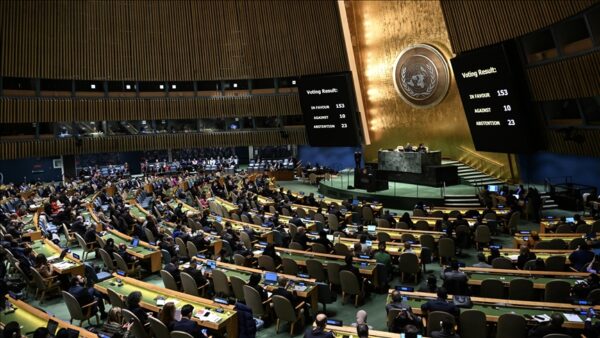
United Nations General Assembly
Act 2:1-21
2:1 When the day of Pentecost had come, they were all together in one place.
2:2 And suddenly from heaven there came a sound like the rush of a violent wind, and it filled the entire house where they were sitting.
2:3 Divided tongues, as of fire, appeared among them, and a tongue rested on each of them.
2:4 All of them were filled with the Holy Spirit and began to speak in other languages, as the Spirit gave them ability.
2:5 Now there were devout Jews from every people under heaven living in Jerusalem.
2:6 And at this sound the crowd gathered and was bewildered, because each one heard them speaking in the native language of each.
2:7 Amazed and astonished, they asked, “Are not all these who are speaking Galileans?
2:8 And how is it that we hear, each of us, in our own native language?
2:9 Parthians, Medes, Elamites, and residents of Mesopotamia, Judea and Cappadocia, Pontus and Asia,
2:10 Phrygia and Pamphylia, Egypt and the parts of Libya belonging to Cyrene, and visitors from Rome, both Jews and proselytes,
2:11 Cretans and Arabs–in our own languages we hear them speaking about God’s deeds of power.”
2:12 All were amazed and perplexed, saying to one another, “What does this mean?”
2:13 But others sneered and said, “They are filled with new wine.”
2:14 But Peter, standing with the eleven, raised his voice and addressed them, “Fellow Jews and all who live in Jerusalem, let this be known to you, and listen to what I say.
2:15 Indeed, these are not drunk, as you suppose, for it is only nine o’clock in the morning.
2:16 No, this is what was spoken through the prophet Joel:
2:17 ‘In the last days it will be, God declares, that I will pour out my Spirit upon all flesh, and your sons and your daughters shall prophesy, and your young men shall see visions, and your old men shall dream dreams.
2:18 Even upon my slaves, both men and women, in those days I will pour out my Spirit, and they shall prophesy.
2:19 And I will show portents in the heaven above and signs on the earth below, blood, and fire, and smoky mist.
2:20 The sun shall be turned to darkness and the moon to blood, before the coming of the Lord’s great and glorious day.
2:21 Then everyone who calls on the name of the Lord shall be saved.’
Sermon: The Language(s) of God
If you’ve ever watched clips of a United Nations meeting on the nightly news, or YouTube, or some other form of media, you can’t help but notice all the translators, and all the equipment that is used to assist ambassadors from around the world in communicating with one another. It’s an impressive sight.
A speaker addresses the convention in their native tongue. As they speak, their words are translated by a team of linguists and transmitted to unique headsets worn by the assembly of 193 global ambassadors. A speech given in Mandarin can be simulcast in English or French or Spanish or Russian or Arabic or dozens of other languages.
Think about the sheer amount of planning and logistics that go into such a process: technology, human capital, time, cooperation, patience, even luck! At Millbrook, it’s an adventure just trying to stabilize our wi-fi for streaming, or prevent the microphone from crackling, or to not forget to change last week’s date on our email or bulletin templates, and that’s without even worrying about multiple languages. But even with all that technology at the UN, there’s still a delay, and there’s still a common denominator. Somebody must know at least two languages. And somebody must still be a mediator.
Now think about that first Pentecost. We’re told that devout Jewish people from all over the city of Jerusalem were present. We’re never told how many people there were, but just for argument’s sake, let’s assume it was 193 pilgrims, who spoke in 193 languages, some of them modern and spoken all over the world; some not yet even invented; some ancient, and no longer spoken: Parthians, Medes, Elamites, and residents of Mesopotamia, Judea and Cappadocia, Pontus and Asia, Phrygia and Pamphylia, Egypt and parts of Libya; and 181 other nations and tongues represented.
In today’s text, each person speaks their native tongue. Think about the sound of 193 people speaking at the same time – even at a normal conversational level, it would be loud. And if they spoke in unison, it would create quite an echo. (Just one other comparison: the bookmarks we handed out this morning represent 126 ways to say peace. Our expression was lovely, but it would be very hard to categorize it as calm!).
But now imagine 193 languages, all rolling off unique tongues. It would sound like a buzz. It would sound chaotic, and frenzied, and almost furious.
And here’s the amazing part: God’s Spirit appears. And the Spirit falls on each person in such a way that each person speaks their own language, and yet each person still understands completely the words their neighbors are speaking.
Back to that UN example: Imagine the person at the podium speaking in Mandarin, and the audience responding in English or Spanish or French or Russian, AND everyone understands each other – no headsets, no translators, no logistics.
Now that’s miraculous!!!
“Okay, fine, Bob,” you say, “it’s a nice miracle, but why is this communications phenomenon relevant for us this morning?”
The author of Luke/Acts understands the significance of language. This author knows that language, even with its great power to unify, has for the most part, been used to divide, or to assimilate, or to diminish others.
Language can be a barrier to foreigners in a foreign land – a weapon even. Don’t believe me? Try traveling somewhere you don’t speak the language. See how helpless you feel to communicate. Try fitting-in in a place with a noticeable accent. Try comprehending legal code, or accounting, or medicine, or auto mechanics without a knowledge of corresponding vocabulary. Language has even been a barrier to the practice of faith: Greek and Latin were inaccessible to the masses, and yet they were the exclusive languages of the Church in the middle centuries.
Language becomes a wall, meant to provide privilege to those inside its perimeter, and defense from those outside its perimeter. And even the pursuit of safety through one-ness becomes threatening. The assimilation into one common tongue strangles the creative fruit born out of diversity. The regional tongues of Macedonia, Judea, Canaan and Cherokee, to name a few, and let’s not forget their customs as well, give way to the forceful, more powerful, more pronounced syllables and cadences of Assyrian, and Babylonian, and Persian, and Greek, and Latin, and English. The languages of empire, the languages of Caesar, swallow up the forgotten languages and customs of the past.
But not today. On Pentecost, the ruach, the Spirit, the sweeping wind of God, the one that blew across a sea of nothingness in Genesis, and tamed the chaos monster, and provided order to our universe – that very same Spirit falls upon you and me, and all the believers in Jerusalem.
But this time, the chaos isn’t a sea monster, or some dark, watery nothingness. This time, the chaos is a false sense of order created by the empires of man – empires who have proclaimed (and still proclaim) one truth, one language, one privileged class, one people – empires who have preached (and still preach) exceptionalism at all costs. On this day, on this sacred day, the ruach blows with unparalleled force, and the earth shakes, and there are tongues of fire, and a thousand languages fill the city. And all are heard. And all have value. And all understand, immediately, profoundly, and affectionately, the presence of God in their midst.
Caesar needs one language. His power is diminished, even lost in translation. If Caesar speaks in one tongue, and his empire hears him in one tongue, his voice is like a fist, and there is no confusion, and his decrees ripple through the land with precision. But language is the link in his chain – his power and precision are diluted with every pause for translation.
Contrast Caesar with God’s Spirit. Their power is demonstrated in Their rawness, in Their fluidity, in Their mysteriousness. Even proclaimed in a thousand tongues, God’s presence is still palpable, and God’s power is still potent.
The day of Pentecost re-affirms and re-calibrates the order of creation: God’s world is once more God’s world. And in God’s world, no matter who you are, you matter! Your essence, your createdness, your very presence, your every breath is beloved by your Creator. It doesn’t matter what language you speak; it doesn’t matter what your zip code is, or the balance of your bank account, or the color of your skin; it doesn’t matter what kind of documentation you have; It doesn’t matter how you identify yourself, even if its different from what your state lawmakers would prefer you put on your ID; It doesn’t matter the person you profess to love, or the past your bring with you, or the burdens you have to carry – it doesn’t matter who, what, when, where and how you are, because, no matter who, what, when, where, and how you are, you matter to God, and you matter to me, and you matter to us. God has deemed you, me, all of us, worthy. God has deemed you, me, all of us, children of God. And with God’s designation, you, me, all of us, have access to God’s Spirit. And we have the power to receive that Spirit, and to proclaim that Spirit, and to use our gifts to make this world a better place.
Friends, it’s the day of Pentecost. And God has put fire in our hearts and flames on our tongues. And regardless of whether our language is modern, or classical, or stilled, or extinct, or even not yet invented – God gives us a voice that is heard, and a voice that is valued. And God gives us ears to listen. We are invited to a Holy dialogue – a place to speak and be heard, and a place to listen and be transformed.
The Spirit of the Lord is upon us! Let’s talk. And let’s listen. And let’s be transformed.
Amen.